Price based on lowest available cruise only fare for double occupancy. Subject to change at any time.
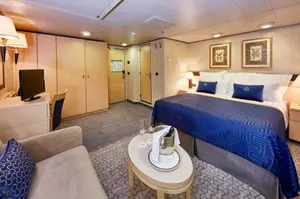
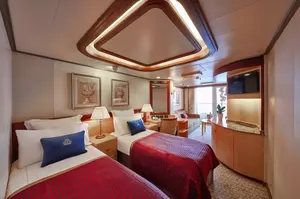
Queen Victoria will delight you with her special appeal, where elegance and unique features combine seamlessly with outstanding hospitality. You'll discover an extraordinary way to see the world.
From the moment you step on board, you're immersed in an enchanting world of pleasure and escapism. Pass leisurely days soaking up the sunshine or gazing out at the tranquil ocean from her light-filled Winter Garden. Learn something new with our Cunard Insights speakers, or simply unwind with a good read. As evening falls, choose from a delectable array of dining options, and enjoy world-class entertainment in the Royal Court Theatre. On Queen Victoria the freedom to create your perfect trip is all yours.
Cruise ID: 56171
| Date | Time | Price * | Booking |
|---|---|---|---|
| 01 June 2026 | €1,023 | Call us to book | |
| 29 June 2026 | €963 | Call us to book |
* Price based on lowest available cruise only fare for double occupancy. Subject to change at any time.
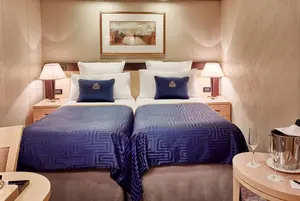
Approximately 159 sq. ft.
Our spacious Britannia Single Inside staterooms are a haven of comfort and style to enjoy during your voyage. You'll find thoughtful features and luxurious amenities, all organised by your dedicated steward to ensure you are always attentively looked after.
Each Britannia Single Inside stateroom includes:
Charges apply to room service after 10:00 AM.
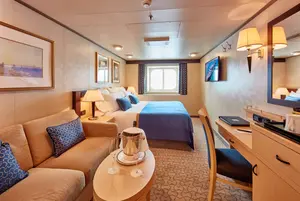
Approximately 133-168 sq. ft.
Positioned to offer sea views, our Britannia Single Oceanview staterooms provide a private enclave from which to watch the world go by. Perfectly framed views are the backdrop to thoughtful features and luxurious amenities, all organised by your dedicated steward to ensure you are always attentively looked after.
Each Britannia Single Oceanview stateroom includes:
Charges apply to room service after 10:00 AM.
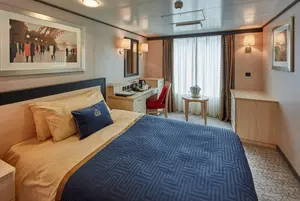
Approximately 197-201 sq. ft.
Positioned to offer sea views, our Britannia Oceanview staterooms provide a private enclave from which to watch the world go by. Perfectly framed views are the backdrop to thoughtful features and luxurious amenities, all organised by your dedicated steward to ensure you are always attentively looked after.
Each Britannia Oceanview stateroom includes:
Charges apply to room service after 10:00 AM.
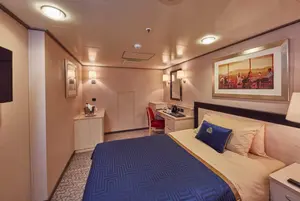
Approximately 152 sq. ft.
With a variety of locations to choose from on board, our well-appointed Britannia Standard Inside staterooms are a haven of comfort and style to enjoy during your voyage. You'll find thoughtful features and luxurious amenities, all organised by your dedicated steward to ensure you are always attentively looked after.
Each Britannia Standard Inside stateroom includes:
Charges apply to room service after 10:00 AM.
Approximately 228-408 sq. ft.
Enjoy access to private, outdoor space in one of our obstructed view Britannia Balcony staterooms. You'll find thoughtful features and luxurious amenities, all organised by your dedicated steward to ensure you are always attentively looked after.
Each Britannia Balcony (obstructed view) stateroom includes:
Charges apply to room service after 10:00 AM.
Approximately 228-408 sq. ft.
Enjoy access to private, outdoor space in one of our obstructed view Britannia Balcony staterooms. You'll find thoughtful features and luxurious amenities, all organised by your dedicated steward to ensure you are always attentively looked after.
Each Britannia Balcony (obstructed view) stateroom includes:
Charges apply to room service after 10:00 AM.
Approximately 200-243 sq. ft.
With a variety of locations to choose from on board, our spacious Britannia Deluxe Inside staterooms are a haven of comfort and style to enjoy during your voyage. You'll find thoughtful features and luxurious amenities, all organised by your dedicated steward to ensure you are always attentively looked after.
Each Britannia Deluxe Inside stateroom includes:
Charges apply to room service after 10:00 AM.
Approximately 254-470 sq. ft.
Take advantage of prime sea views from your own private, outdoor space in one of our Britannia Club Balcony staterooms. You'll find thoughtful features, luxurious amenities and benefits, all organised by your dedicated steward to ensure you are always attentively looked after.
Each Britannia Club Balcony stateroom includes:
Charges apply to room service after 10:00 AM.
Approximately 228-408 sq. ft.
Enjoy access to private, outdoor space in one of our obstructed view Britannia Balcony staterooms. You'll find thoughtful features and luxurious amenities, all organised by your dedicated steward to ensure you are always attentively looked after.
Charges apply to room service after 10:00 AM.
Approximately 228-472 sq. ft.
Drink in sparkling sea views from your own private, outdoor space in one of our Britannia Balcony staterooms. You'll find thoughtful features and luxurious amenities, all organised by your dedicated steward to ensure you are always attentively looked after.
Each Britannia Balcony stateroom includes:
Charges apply to room service after 10:00 AM.
Approximately 335-513 sq. ft.
Delight in a prime location on board with sea views that can be enjoyed from both in and outside your Princess Suite. You'll find thoughtful features and luxurious amenities, all organised by your dedicated steward to ensure you are always attentively looked after.
Each Princess Grill Suite includes:
Approximately 1100 sq. ft.
Retreat to an exclusive world of luxury with your own private residence at sea. Bold Cunard accent colours and thoughtful designs bring each space in your suite to life. An attentive butler is on hand at all times to truly customise your voyage experience.
Each Queens Grill Master Suite includes:
Approximately 484-596 sq. ft.
Retreat to an exclusive world of luxury with your own private residence at sea. Bold Cunard accent colours and thoughtful designs bring each space in your suite to life. An attentive butler is on hand at all times to truly customise your voyage experience.
Each Queens Grill Penthouse Suite includes:
Approximately 1319-1555 sq. ft.
Retreat to an exclusive world of luxury with your own private residence at sea. Striking interior designs bring each space in your suite to life, indulging your senses with a rich tapestry of colours, materials, and art. An attentive butler is on hand at all times to truly customise your voyage experience.
The Queens Grill Grand Suite includes:
Approximately 484-757 sq. ft.
Retreat to an exclusive world of luxury with your own private residence at sea. Bold Cunard accent colours and thoughtful designs bring each space in your suite to life. An attentive butler is on hand at all times to truly customise your voyage experience.
Each Queens Grill Suite includes:
Day 1 Civitavecchia, Italy
Italy's vibrant capital lives in the present, but no other city on earth evokes its past so powerfully. For over 2,500 years, emperors, popes, artists, and common citizens have left their mark here. Archaeological remains from ancient Rome, art-stuffed churches, and the treasures of Vatican City vie for your attention, but Rome is also a wonderful place to practice the Italian-perfected il dolce far niente, the sweet art of idleness. Your most memorable experiences may include sitting at a caffè in the Campo de' Fiori or strolling in a beguiling piazza.
Day 2 Messina Strait, Italy
Day 3 Cephalonia, Greece
Day 4 Corfu, Greece
Corfu town today is a vivid tapestry of cultures—a sophisticated weave, where charm, history, and natural beauty blend. Located about midway along the island's east coast, this spectacularly lively capital is the cultural heart of Corfu and has a remarkable historic center that UNESCO designated as a World Heritage Site in 2007. All ships and planes dock or land near Corfu town, which occupies a small peninsula jutting into the Ionian Sea.Whether arriving by ferry from mainland Greece or Italy, from another island, or directly by plane, catch your breath by first relaxing with a coffee or a gelato in Corfu town's shaded Liston Arcade, then stroll the narrow lanes of its pedestrians-only quarter. For an overview of the immediate area, and a quick tour of Mon Repos palace, hop on the little tourist train that runs from May to September. Corfu town has a different feel at night, so book a table at one of its famed tavernas to savor the island's unique cuisine.The best way to get around Corfu town is on foot. The town is small enough so that you can easily walk to every sight. There are local buses, but they do not thread their way into the streets (many now car-free) of the historic center. If you are arriving by ferry or plane, it's best to take a taxi to your hotel. Expect to pay about €10 from the airport or ferry terminal to a hotel in Corfu town. If there are no taxis waiting, you can call for one.
Day 5 Kotor, Montenegro
Backed by imposing mountains, tiny Kotor lies hidden from the open sea, tucked into the deepest channel of the Bokor Kotorska (Kotor Bay), which is Europe's most southerly fjord. To many, this town is more charming than its sister UNESCO World Heritage Site, Dubrovnik, retaining more authenticity, but with fewer tourists and spared the war damage and subsequent rebuilding which has given Dubrovnik something of a Disney feel.Kotor's medieval Stari Grad (Old Town) is enclosed within well-preserved defensive walls built between the 9th and 18th centuries and is presided over by a proud hilltop fortress. Within the walls, a labyrinth of winding cobbled streets leads through a series of splendid paved piazzas, rimmed by centuries-old stone buildings. The squares are now haunted by strains from buskers but although many now house trendy cafés and chic boutiques, directions are still given medieval-style by reference to the town's landmark churches.In the Middle Ages, as Serbia's chief port, Kotor was an important economic and cultural center with its own highly regarded schools of stonemasonry and iconography. From 1391 to 1420 it was an independent city-republic and later, it spent periods under Venetian, Austrian, and French rule, though it was undoubtedly the Venetians who left the strongest impression on the city's architecture. Since the breakup of Yugoslavia, some 70% of the stone buildings in the romantic Old Town have been snapped up by foreigners, mostly Brits and Russians. Porto Montenegro, a new marina designed to accommodate some of the world's largest super yachts, opened in nearby Tivat in 2011, and along the bay are other charming seaside villages, all with better views of the bay than the vista from Kotor itself where the waterside is congested with cruise ships and yachts. Try sleepy Muo or the settlement of Prcanj in one direction around the bay, or Perast and the Roman mosaics of Risan in the other direction.
Day 6 Split, Croatia
Split's ancient core is so spectacular and unusual that a visit is more than worth your time. The heart of the city lies within the walls of Roman emperor Diocletian's retirement palace, which was built in the 3rd century AD. Diocletian, born in the nearby Roman settlement of Salona in AD 245, achieved a brilliant career as a soldier and became emperor at the age of 40. In 295 he ordered this vast palace to be built in his native Dalmatia, and when it was completed he stepped down from the throne and retired to his beloved homeland. Upon his death, he was laid to rest in an octagonal mausoleum, around which Split's magnificent cathedral was built.In 615, when Salona was sacked by barbarian tribes, those fortunate enough to escape found refuge within the stout palace walls and divided up the vast imperial apartments into more modest living quarters. Thus, the palace developed into an urban center, and by the 11th century the settlement had expanded beyond the ancient walls.Under the rule of Venice (1420–1797), Split—as a gateway to the Balkan interior—became one of the Adriatic's main trading ports, and the city's splendid Renaissance palaces bear witness to the affluence of those times. When the Habsburgs took control during the 19th century, an overland connection to Central Europe was established by the construction of the Split–Zagreb–Vienna railway line.After World War II, the Tito years saw a period of rapid urban expansion: industrialization accelerated and the suburbs extended to accommodate high-rise apartment blocks. Today the historic center of Split is included on UNESCO's list of World Heritage Sites.
Day 7 Cruising
Day 8 Trieste, Italy
Up until the end of World War I, Trieste was the only port of the vast Austro-Hungarian Empire and therefore a major industrial and financial center. In the early years of the 20th century, Trieste and its surroundings also became famous by their association with some of the most important names of Italian literature, such as Italo Svevo, and English and German letters. James Joyce drew inspiration from the city's multiethnic population, and Rainer Maria Rilke was inspired by the seacoast west of the city. Although it has lost its importance as a port and a center of finance, it has never fully lost its roll as an intellectual center. The streets hold a mix of monumental, neoclassical, and art-nouveau architecture built by the Austrians during Trieste's days of glory, granting an air of melancholy stateliness to a city that lives as much in the past as the present.
Day 1 Civitavecchia, Italy
Italy's vibrant capital lives in the present, but no other city on earth evokes its past so powerfully. For over 2,500 years, emperors, popes, artists, and common citizens have left their mark here. Archaeological remains from ancient Rome, art-stuffed churches, and the treasures of Vatican City vie for your attention, but Rome is also a wonderful place to practice the Italian-perfected il dolce far niente, the sweet art of idleness. Your most memorable experiences may include sitting at a caffè in the Campo de' Fiori or strolling in a beguiling piazza.
Day 2 Messina Strait, Italy
Day 3 Cephalonia, Greece
Day 4 Corfu, Greece
Corfu town today is a vivid tapestry of cultures—a sophisticated weave, where charm, history, and natural beauty blend. Located about midway along the island's east coast, this spectacularly lively capital is the cultural heart of Corfu and has a remarkable historic center that UNESCO designated as a World Heritage Site in 2007. All ships and planes dock or land near Corfu town, which occupies a small peninsula jutting into the Ionian Sea.Whether arriving by ferry from mainland Greece or Italy, from another island, or directly by plane, catch your breath by first relaxing with a coffee or a gelato in Corfu town's shaded Liston Arcade, then stroll the narrow lanes of its pedestrians-only quarter. For an overview of the immediate area, and a quick tour of Mon Repos palace, hop on the little tourist train that runs from May to September. Corfu town has a different feel at night, so book a table at one of its famed tavernas to savor the island's unique cuisine.The best way to get around Corfu town is on foot. The town is small enough so that you can easily walk to every sight. There are local buses, but they do not thread their way into the streets (many now car-free) of the historic center. If you are arriving by ferry or plane, it's best to take a taxi to your hotel. Expect to pay about €10 from the airport or ferry terminal to a hotel in Corfu town. If there are no taxis waiting, you can call for one.
Day 5 Kotor, Montenegro
Backed by imposing mountains, tiny Kotor lies hidden from the open sea, tucked into the deepest channel of the Bokor Kotorska (Kotor Bay), which is Europe's most southerly fjord. To many, this town is more charming than its sister UNESCO World Heritage Site, Dubrovnik, retaining more authenticity, but with fewer tourists and spared the war damage and subsequent rebuilding which has given Dubrovnik something of a Disney feel.Kotor's medieval Stari Grad (Old Town) is enclosed within well-preserved defensive walls built between the 9th and 18th centuries and is presided over by a proud hilltop fortress. Within the walls, a labyrinth of winding cobbled streets leads through a series of splendid paved piazzas, rimmed by centuries-old stone buildings. The squares are now haunted by strains from buskers but although many now house trendy cafés and chic boutiques, directions are still given medieval-style by reference to the town's landmark churches.In the Middle Ages, as Serbia's chief port, Kotor was an important economic and cultural center with its own highly regarded schools of stonemasonry and iconography. From 1391 to 1420 it was an independent city-republic and later, it spent periods under Venetian, Austrian, and French rule, though it was undoubtedly the Venetians who left the strongest impression on the city's architecture. Since the breakup of Yugoslavia, some 70% of the stone buildings in the romantic Old Town have been snapped up by foreigners, mostly Brits and Russians. Porto Montenegro, a new marina designed to accommodate some of the world's largest super yachts, opened in nearby Tivat in 2011, and along the bay are other charming seaside villages, all with better views of the bay than the vista from Kotor itself where the waterside is congested with cruise ships and yachts. Try sleepy Muo or the settlement of Prcanj in one direction around the bay, or Perast and the Roman mosaics of Risan in the other direction.
Day 6 Split, Croatia
Split's ancient core is so spectacular and unusual that a visit is more than worth your time. The heart of the city lies within the walls of Roman emperor Diocletian's retirement palace, which was built in the 3rd century AD. Diocletian, born in the nearby Roman settlement of Salona in AD 245, achieved a brilliant career as a soldier and became emperor at the age of 40. In 295 he ordered this vast palace to be built in his native Dalmatia, and when it was completed he stepped down from the throne and retired to his beloved homeland. Upon his death, he was laid to rest in an octagonal mausoleum, around which Split's magnificent cathedral was built.In 615, when Salona was sacked by barbarian tribes, those fortunate enough to escape found refuge within the stout palace walls and divided up the vast imperial apartments into more modest living quarters. Thus, the palace developed into an urban center, and by the 11th century the settlement had expanded beyond the ancient walls.Under the rule of Venice (1420–1797), Split—as a gateway to the Balkan interior—became one of the Adriatic's main trading ports, and the city's splendid Renaissance palaces bear witness to the affluence of those times. When the Habsburgs took control during the 19th century, an overland connection to Central Europe was established by the construction of the Split–Zagreb–Vienna railway line.After World War II, the Tito years saw a period of rapid urban expansion: industrialization accelerated and the suburbs extended to accommodate high-rise apartment blocks. Today the historic center of Split is included on UNESCO's list of World Heritage Sites.
Day 7 Cruising
Day 8 Trieste, Italy
Up until the end of World War I, Trieste was the only port of the vast Austro-Hungarian Empire and therefore a major industrial and financial center. In the early years of the 20th century, Trieste and its surroundings also became famous by their association with some of the most important names of Italian literature, such as Italo Svevo, and English and German letters. James Joyce drew inspiration from the city's multiethnic population, and Rainer Maria Rilke was inspired by the seacoast west of the city. Although it has lost its importance as a port and a center of finance, it has never fully lost its roll as an intellectual center. The streets hold a mix of monumental, neoclassical, and art-nouveau architecture built by the Austrians during Trieste's days of glory, granting an air of melancholy stateliness to a city that lives as much in the past as the present.

The Department of Foreign Affairs has up-to-date advice for Irish citizens on staying safe and healthy abroad. For more security, local laws, health, passport and visa information see https://www.ireland.ie/en/dfa/overseas-travel/ and follow dfatravelwise