Price based on lowest available cruise only fare for double occupancy. Subject to change at any time.
Join us on Queen Elizabeth and immerse yourself in her evocative art deco elegance. This stunning Queen exudes style and has an especially refined feel. Prepare yourself for a truly remarkable voyage.
Queen Elizabeth invites you to an uncrowded world where spacious decks set the perfect backdrop for you to savour a flawless Cunard experience. Immerse yourself in endless entertainment, luxurious accommodation and an array of dining choices. Her art deco features and gleaming chandeliers blend with contemporary attractions to ensure a remarkable holiday. Enjoy croquet on her Games Deck, stunning entertainment in her Royal Court Theatre or relax in her elegant conservatory. The choice, as always with Cunard, is yours.
Cruise ID: 63596
| Date | Time | Price * | Booking |
|---|---|---|---|
| 15 October 2027 | €975 | Call us to book |
* Price based on lowest available cruise only fare for double occupancy. Subject to change at any time.
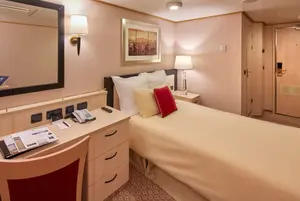
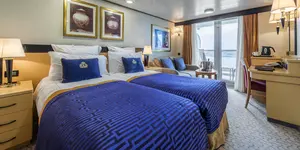
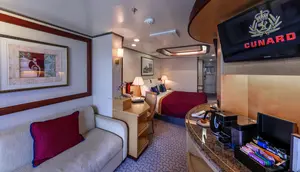
Our spacious Britannia Single Inside staterooms are a haven of comfort and style to enjoy during your voyage. You'll find thoughtful features and luxurious amenities all organised by your dedicated steward to ensure you are always attentively looked after.
Each Britannia Single Inside stateroom includes:
Charges apply to room service after 10:00 AM.
Approximately 133-168 sq. ft.
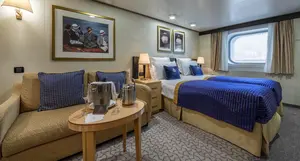
Positioned to offer sea views, our Britannia Single Oceanview staterooms provide a private enclave from which to watch the world go by. Perfectly framed views are the backdrop to thoughtful features and luxurious amenities, all organised by your dedicated steward to ensure you are always attentively looked after.
Each Britannia Single Oceanview stateroom includes:
Charges apply to room service after 10:00 AM.
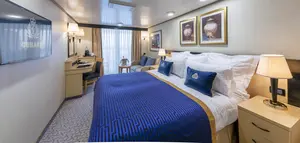
With a variety of locations to choose from on board our well-appointed Britannia Standard Inside staterooms are a haven of comfort and style to enjoy during your voyage. You'll find thoughtful features and luxurious amenities all organised by your dedicated steward to ensure you are always attentively looked after.
Each Britannia Standard Inside stateroom includes:
Charges apply to room service after 10:00 AM.
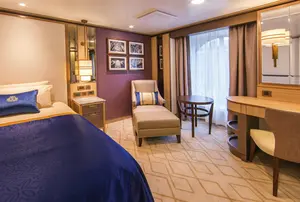
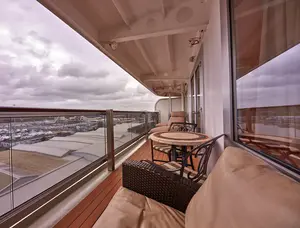
Enjoy access to private outdoor space in one of our obstructed view Britannia Balcony staterooms. You'll find thoughtful features and luxurious amenities all organised by your dedicated steward to ensure you are always attentively looked after.
Each Britannia Balcony (obstructed view) stateroom includes:
Charges apply to room service after 10:00 AM.
Enjoy access to private, outdoor space in one of our obstructed view Britannia Balcony staterooms. You'll find thoughtful features and luxurious amenities, all organised by your dedicated steward to ensure you are always attentively looked after.
Each Britannia Balcony (obstructed view) stateroom includes:
Charges apply to room service after 10:00 AM.
With a variety of locations to choose from on board our spacious Britannia Deluxe Inside staterooms are a haven of comfort and style to enjoy during your voyage. You'll find thoughtful features and luxurious amenities all organised by your dedicated steward to ensure you are always attentively looked after.
Each Britannia Deluxe Inside stateroom includes:
Charges apply to room service after 10:00 AM.
Our Britannia Oceanview (obstructed view) staterooms provide a private enclave from which to watch the world go by. You'll find thoughtful features and luxurious amenities all organised by your dedicated steward to ensure you are always attentively looked after.
Each Britannia Oceanview (obstructed view) stateroom includes:
Charges apply to room service after 10:00 AM.
Positioned to offer sea views our Britannia Oceanview staterooms provide a private enclave from which to watch the world go by. Perfectly framed views are the backdrop to thoughtful features and luxurious amenities all organised by your dedicated steward to ensure you are always attentively looked after.
Each Britannia Oceanview stateroom includes:
Charges apply to room service after 10:00 AM.
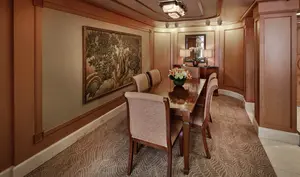
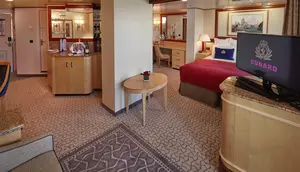
Retreat to an exclusive world of luxury with your own private residence at sea. Bold Cunard accent colours and thoughtful designs bring each space in your suite to life.
Each spacious suite has been designed to the highest standard of luxury and epitomises the ultimate in refined accommodation. With space to relax, dine, and entertain, your Queens Grill Suite will suit your needs any time of day. As you get ready for the day or your evening out, your spacious bathroom offers an array of tempting Penhaligon's toiletries to choose from.
With luxury robes and slippers, speciality tea and coffee service, complimentary mini-bar, and the option to dine in at any time, you may never want to leave your suite. No matter what you choose, you will delight in the service of your attentive butler and steward, who are on hand to ensure all the finer details are taken care of.
The Queens Grill Grand Suite includes:
Retreat to an exclusive world of luxury with your own private residence at sea. Bold Cunard accent colours and thoughtful designs bring each space in your suite to life.
Each spacious suite has been designed to the highest standard of luxury and epitomises the ultimate in refined accommodation. With space to relax, dine, and entertain, your Queens Grill Suite will suit your needs any time of day. As you get ready for the day or your evening out, your spacious bathroom offers an array of tempting Penhaligon's toiletries to choose from.
With luxury robes and slippers, speciality tea and coffee service, complimentary mini-bar, and the option to dine in at any time, you may never want to leave your suite. No matter what you choose, you will delight in the service of your attentive butler and steward, who are on hand to ensure all the finer details are taken care of.
Each Queens Grill Suite includes:
Retreat to an exclusive world of luxury with your own private residence at sea. Bold Cunard accent colours and thoughtful designs bring each space in your suite to life.
Each spacious suite has been designed to the highest standard of luxury and epitomises the ultimate in refined accommodation. With space to relax, dine, and entertain, your Queens Grill Suite will suit your needs any time of day. As you get ready for the day or your evening out, your spacious bathroom offers an array of tempting Penhaligon's toiletries to choose from.
With luxury robes and slippers, speciality tea and coffee service, complimentary mini-bar, and the option to dine in at any time, you may never want to leave your suite. No matter what you choose, you will delight in the service of your attentive butler and steward, who are on hand to ensure all the finer details are taken care of.
Each Queens Grill Penthouse includes:
Retreat to an exclusive world of luxury with your own private residence at sea. Bold Cunard accent colours and thoughtful designs bring each space in your suite to life.
Each spacious suite has been designed to the highest standard of luxury and epitomises the ultimate in refined accommodation. With space to relax, dine, and entertain, your Queens Grill Suite will suit your needs any time of day. As you get ready for the day or your evening out, your spacious bathroom offers an array of tempting Penhaligon's toiletries to choose from.
With luxury robes and slippers, speciality tea and coffee service, complimentary mini-bar, and the option to dine in at any time, you may never want to leave your suite. No matter what you choose, you will delight in the service of your attentive butler and steward, who are on hand to ensure all the finer details are taken care of.
Each Queens Grill Master Suite includes:
Drink in sparkling sea views from your own private outdoor space in one of our Britannia Balcony staterooms. You'll find thoughtful features and luxurious amenities all organised by your dedicated steward to ensure you are always attentively looked after.
Your Britannia Balcony stateroom includes:
Charges apply to room service after 10:00 AM.
Delight in a prime location on board with sea views that can be enjoyed from both in and outside your Princess Grill Suite. You'll find thoughtful features and luxurious amenities all organised by your dedicated steward to ensure you are always attentively looked after.
Each Princess Grill Suite includes:
Day 1 Civitavecchia, Italy
Italy's vibrant capital lives in the present, but no other city on earth evokes its past so powerfully. For over 2,500 years, emperors, popes, artists, and common citizens have left their mark here. Archaeological remains from ancient Rome, art-stuffed churches, and the treasures of Vatican City vie for your attention, but Rome is also a wonderful place to practice the Italian-perfected il dolce far niente, the sweet art of idleness. Your most memorable experiences may include sitting at a caffè in the Campo de' Fiori or strolling in a beguiling piazza.
Day 2 Cruising
Day 3 Palermo, Italy
Once the intellectual capital of southern Europe, Palermo has always been at the crossroads of civilization. Favorably situated on a crescent-shaped bay at the foot of Monte Pellegrino, it has attracted almost every culture touching the Mediterranean world. To Palermo's credit, it has absorbed these diverse cultures into a unique personality that is at once Arab and Christian, Byzantine and Roman, Norman and Italian. The city's heritage encompasses all of Sicily's varied ages, but its distinctive aspect is its Arab-Norman identity, an improbable marriage that, mixed in with Byzantine and Jewish elements, created some resplendent works of art. No less noteworthy than the architecture is Palermo's chaotic vitality, on display at some of Italy's most vibrant outdoor markets, public squares, street bazaars, and food vendors, and above all in its grand climax of Italy's most spectacular passeggiata (the leisurely social stroll along the principal thoroughfare).
Day 4 Messina Strait, Italy
Day 5 Corfu, Greece
Corfu town today is a vivid tapestry of cultures—a sophisticated weave, where charm, history, and natural beauty blend. Located about midway along the island's east coast, this spectacularly lively capital is the cultural heart of Corfu and has a remarkable historic center that UNESCO designated as a World Heritage Site in 2007. All ships and planes dock or land near Corfu town, which occupies a small peninsula jutting into the Ionian Sea.Whether arriving by ferry from mainland Greece or Italy, from another island, or directly by plane, catch your breath by first relaxing with a coffee or a gelato in Corfu town's shaded Liston Arcade, then stroll the narrow lanes of its pedestrians-only quarter. For an overview of the immediate area, and a quick tour of Mon Repos palace, hop on the little tourist train that runs from May to September. Corfu town has a different feel at night, so book a table at one of its famed tavernas to savor the island's unique cuisine.The best way to get around Corfu town is on foot. The town is small enough so that you can easily walk to every sight. There are local buses, but they do not thread their way into the streets (many now car-free) of the historic center. If you are arriving by ferry or plane, it's best to take a taxi to your hotel. Expect to pay about €10 from the airport or ferry terminal to a hotel in Corfu town. If there are no taxis waiting, you can call for one.
Day 6 Dubrovnik, Croatia
Nothing can prepare you for your first sight of Dubrovnik. Lying 216 km (135 miles) southeast of Split and commanding a jaw-dropping coastal location, it is one of the world's most beautiful fortified cities. Its massive stone ramparts and fortress towers curve around a tiny harbor, enclosing graduated ridges of sun-bleached orange-tiled roofs, copper domes, and elegant bell towers. Your imagination will run wild picturing what it looked like seven centuries ago when the walls were built, without any suburbs or highways around it, just this magnificent stone city rising out of the sea.In the 7th century AD, residents of the Roman city Epidaurum (now Cavtat) fled the Avars and Slavs of the north and founded a new settlement on a small rocky island, which they named Laus, and later Ragusa. On the mainland hillside opposite the island, the Slav settlement called Dubrovnik grew up. In the 12th century the narrow channel separating the two settlements was filled in (now the main street through the Old Town, called Stradun), and Ragusa and Dubrovnik became one. The city was surrounded by defensive walls during the 13th century, and these were reinforced with towers and bastions in the late 15th century.From 1358 to 1808 the city thrived as a powerful and remarkably sophisticated independent republic, reaching its golden age during the 16th century. In 1667 many of its splendid Gothic and Renaissance buildings were destroyed by an earthquake. The defensive walls survived the disaster, and the city was rebuilt in baroque style.Dubrovnik lost its independence to Napoléon in 1808, and in 1815 passed to Austria-Hungary. During the 20th century, as part of Yugoslavia, the city became a popular tourist destination, and in 1979 it was listed as a UNESCO World Heritage Site. During the war for independence, it came under heavy siege. Thanks to careful restoration, few traces of damage remain; however, there are maps inside the Pile and Ploce Gates illustrating the points around the city where damage was done. It's only when you experience Dubrovnik yourself that you can understand what a treasure the world nearly lost
Day 7 Zadar, Croatia
Dalmatia's capital for more than 1,000 years, Zadar is all too often passed over by travelers on their way to Split or Dubrovnik. What they miss out on is a city of more than 73,000 that is remarkably lovely and lively despite—and, in some measure, because of—its tumultuous history. The Old Town, separated from the rest of the city on a peninsula some 4 km (2½ miles) long and just 1,640 feet wide, is bustling and beautiful: the marble pedestrian streets are replete with Roman ruins, medieval churches, palaces, museums, archives, and libraries. Parts of the new town are comparatively dreary, a testament to what a world war followed by decades of communism, not to mention a civil war, can do to the architecture of a city that is 3,000 years old. A settlement had already existed on the site of the present-day city for some 2,000 years when Rome finally conquered Zadar in the 1st century BC; the foundations of the forum can be seen today. Before the Romans came the Liburnians had made it a key center for trade with the Greeks and Romans for 800 years. In the 3rd century BC the Romans began to seriously pester the Liburnians, but required two centuries to bring the area under their control. During the Byzantine era, Zadar became the capital of Dalmatia, and this period saw the construction of its most famous church, the 9th-century St. Donat's Basilica. It remained the region's foremost city through the ensuing centuries. The city then experienced successive onslaughts and occupations—both long and short—by the Osogoths, the Croatian-Hungarian kings, the Venetians, the Turks, the Habsburgs, the French, the Habsburgs again, and finally the Italians before becoming part of Yugoslavia and, in 1991, the independent republic of Croatia. Zadar was for centuries an Italian-speaking city, and Italian is still spoken widely, especially by older people. Indeed, it was ceded to Italy in 1921 under the Treaty of Rapallo (and reverted to its Italian name of Zara). Its occupation by the Germans from 1943 led to intense bombing by the Allies during World War II, which left most of the city in ruins. Zadar became part of Tito's Yugoslavia in 1947, prompting many Italian residents to leave. Zadar's most recent ravages occurred during a three-month siege by Serb forces and months more of bombardment during the Croatian-Serbian war between 1991 and 1995. But you'd be hard-pressed to find outward signs of this today in what is a city to behold. There are helpful interpretive signs in English all around the Old Town, so you certainly won't feel lost when trying to make sense of the wide variety of architectural sites you might otherwise pass by with only a cursory look.
Day 8 Trieste, Italy
Up until the end of World War I, Trieste was the only port of the vast Austro-Hungarian Empire and therefore a major industrial and financial center. In the early years of the 20th century, Trieste and its surroundings also became famous by their association with some of the most important names of Italian literature, such as Italo Svevo, and English and German letters. James Joyce drew inspiration from the city's multiethnic population, and Rainer Maria Rilke was inspired by the seacoast west of the city. Although it has lost its importance as a port and a center of finance, it has never fully lost its roll as an intellectual center. The streets hold a mix of monumental, neoclassical, and art-nouveau architecture built by the Austrians during Trieste's days of glory, granting an air of melancholy stateliness to a city that lives as much in the past as the present.
The Department of Foreign Affairs has up-to-date advice for Irish citizens on staying safe and healthy abroad. For more security, local laws, health, passport and visa information see https://www.ireland.ie/en/dfa/overseas-travel/ and follow dfatravelwise